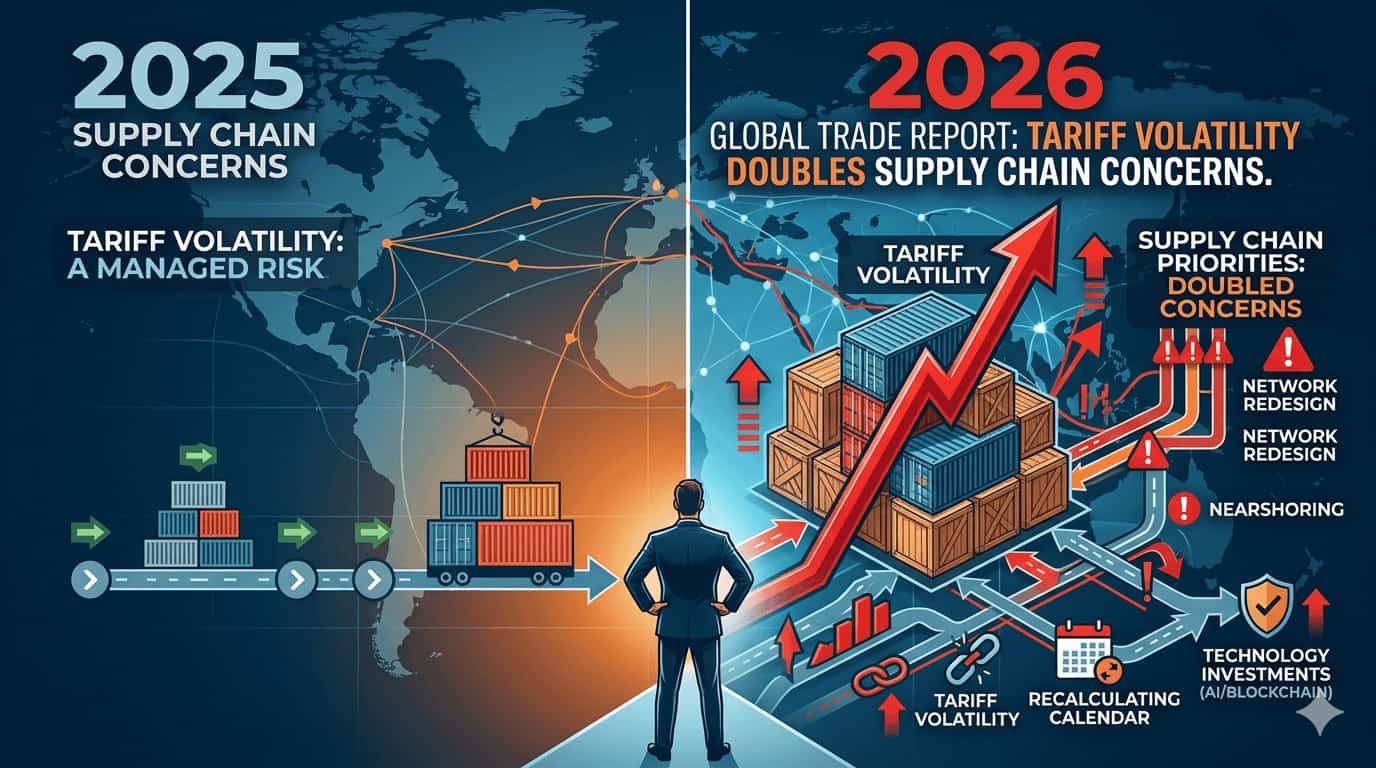
Tariff volatility used to be something companies factored in once a quarter, maybe flagged in a board presentation, then mostly ignored. That’s changed. The Thomson Reuters 2026 Global Trade Report — drawn from 225 upper-level trade professionals across North America, the EU, the UK, Latin America, and Asia Pacific — found that 72% now cite U.S. tariff volatility as the single most impactful regulatory or customs change they’re dealing with. A year ago, that number was 41%.
Supply chain management has climbed to the top strategic priority for 68% of respondents — nearly double the 35% who said the same last year. Now procurement teams, trade compliance officers, and logistics leads are treating tariffs as a force that can rewire sourcing strategies, compress landed costs, trigger HTS reclassification headaches, strain safety stock levels, and blow up customer SLAs all at once.
That shift is happening because leaders increasingly believe this environment will last. In the same report, 76% of surveyed trade professionals said the new U.S. tariffs look like a more permanent approach that could remain in place for at least the next four years, not a short-term policy tool.
Companies are responding accordingly. Some are even taking the hit directly: 39% said their organizations are absorbing or considering absorbing tariff costs rather than passing them on to customers, up sharply from 13% a year earlier. That is a major sign of pressure on pricing power. When businesses start eating tariff costs to protect market share, supply chain strategy stops being a back-office function and becomes a frontline business decision tied to profitability, customer retention, and competitive positioning.
One of the biggest supply chain trends in 2026 is network redesign. Companies are changing how and where they buy, build, and move product. Thomson Reuters found that 65% of respondents are changing sourcing patterns, 57% are renegotiating supplier contracts, and 51% are pursuing nearshoring or moving manufacturing closer to home. That mix tells a bigger story than simple “reshoring.”
Businesses are building optionality. They want more than one supplier, more than one lane, and more than one region in play in case tariffs shift again. In practice, that means more dual sourcing, shorter contract cycles, deeper supplier reviews, and a wider use of trade zones and preference programs. The old model focused heavily on lowest landed cost. The 2026 model puts a premium on flexibility, speed of adjustment, and the ability to reroute without blowing up service levels.
A second major trend is that compliance has become an operational issue, not a legal afterthought. Tariffs are still the headline, but they now sit beside a growing layer of non-tariff complexity. Thomson Reuters reports that 87% of respondents expect to be highly or moderately affected by the U.S. elimination of the de minimis exemption. The report also points to expanding pressures from export controls, carbon border rules, corporate transparency rules, and new data residency requirements in China starting in January 2026.
UNCTAD sees the same broader pattern globally: since 2020, around 18,000 discriminatory trade measures have been introduced, and technical regulations plus sanitary standards now affect about two thirds of world trade. The supply chain implication is huge. More shipments now require stronger origin data, tighter product classification, better documentation, and more internal coordination before goods move.
That is one reason technology spending is rising fast in trade and supply chain functions. Thomson Reuters found that 40% of respondents say their companies are exploring AI or blockchain for trade management, up from just 6% in 2024. The top technology priorities are practical: better visibility into supply chains, stronger supply chain security and data protection, predictive analytics, transaction compliance, and insights into changing tariffs and their impact.
There’s something very 2026 about this shift. The days of vague “digital transformation” conversations are over. Companies want tools that actually do something: flag sourcing exposure, model landed cost shifts, sharpen classification accuracy, and warn teams about disruptions before those disruptions reach orders and customers. Tech budgets are moving toward risk sensing and decision support. The era of shiny experimentation for its own sake appears to be winding down.
Here’s the thing though: 2026 is not a story of globalization falling apart. Trade is getting rewired. DHL’s Global Connectedness Report 2026 puts the world’s globalization level at 25% in 2025, matching the record high first reached in 2022. Global goods trade grew faster last year than in any year since 2017, pandemic rebound years excluded, and DHL projects average annual goods trade growth of 2.6% through 2029.
UNCTAD puts global trade above $35 trillion in 2025 — a first, after 7% growth — even with expectations of slower expansion ahead as the environment gets more fragmented. Cross-border trade is still growing. What’s changing are the routes, the sourcing maps, and the market priorities, all of them shifting under pressure from tariffs, geopolitics, and regulation.
That reconfiguration is showing up in several other current trends. UNCTAD says services now account for 27% of global trade and grew about 9% in 2025, far faster than goods, while digitally deliverable services make up 56% of global services exports. It also reports that South-South trade has become a major engine of growth, with 57% of developing-country exports now going to other developing economies.
Environmental rules have crossed a threshold. Carbon pricing and the EU carbon border mechanism are real cost variables now. From 2026 onward, they start reshaping competitiveness in ways that show up in actual margins.
For supply chain leaders, that changes the math on resilience. Product flow matters, sure, but the list of dependencies has gotten longer: digital capability, regional diversification, carbon reporting readiness, access to fast-growing nontraditional trade corridors. Get one of those wrong, and the others can’t fully compensate.
Costs are proving to be more stubborn than most teams hoped. Kearney’s 2026 H1 Supply Chain Navigator forecasts supply chain costs rising 2.3% to 4.0% above inflation through 2026. Trade policy, critical minerals constraints, geopolitical friction, and still-elevated inventories are all contributors. KPMG puts the strategic implication plainly: resilience is the common theme now. Companies are leaning on supplier diversification, nearshoring, inventory buffers, and new technologies to make their supply chains less fragile.
In 2026, supply chains are being judged less by how cheaply they can run in ideal conditions and more by how well they can keep running in messy ones. The premium is on survivability with acceptable cost rather than perfect efficiency.
The bigger business consequence is that trade and supply chain teams now have more influence inside the organization. Thomson Reuters found that 72% of respondents are seeing increased influence at the executive level, and many also reported greater involvement in procurement decisions, stronger recognition as strategic partners, and more collaboration across the business. That makes sense. When tariff volatility can hit margin, product availability, compliance risk, and customer promises in the same quarter, leaders need supply chain and trade input much earlier in decision-making.
The 2026 Global Trade Report makes the tariff story hard to ignore. Supply chain concerns have roughly doubled year over year. But the deeper story is about what companies are actually doing in response. Supply chains are getting rebuilt around resilience, visibility, compliance discipline, and faster strategic response. The companies that come out ahead won’t be the ones waiting for things to settle down. They’ll be the ones designed to operate through the turbulence itself.
Leave a Reply